
Bricks are one of the building materials used by people for thousands of years.
They are still used today in construction because they are strong, versatile and not too expensive.
Bricks are used to build homes, offices, factories, walls and other structures.
Choosing the type of brick is important to ensure that the building is strong, lasts long and looks good.
There are types of bricks available today each made in a different way and used for specific purposes.
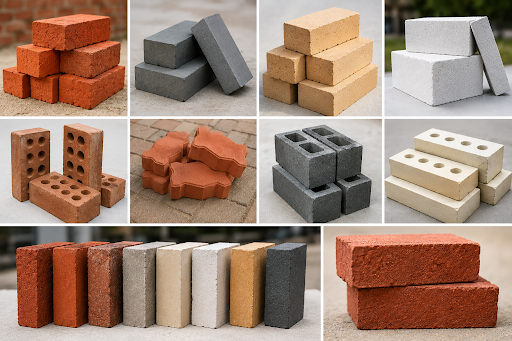
Some common types of bricks include burnt clay bricks, fly ash bricks, concrete bricks and fire bricks.
Each type of brick has its advantages and disadvantages.
For example:
- burnt clay bricks are strong and durable. They can absorb water.
- Fly ash bricks are environmentally friendly. Have a smooth surface.
Bricks are made from materials like clay, sand and lime or from engineered materials like concrete.
They are laid together with mortar to create durable structures.
Bricks are used to build walls, foundations, pavements and other structural elements.
Bricks are important in construction because they provide a balance of strength, durability and affordability.
They are suitable for climates and building types.
Some of the benefits of using bricks include their compressive strength, long service life and fire resistance.
Types of Bricks
Burnt Clay Bricks:
These are the most widely used type of brick.
They are made by molding clay into shapes, drying them and firing them in kilns at high temperatures.
They are suitable for load-bearing walls and general masonry work.
Fly Ash Bricks:
These bricks are made using fly ash, cement, sand and water under pressure.
They are environmentally friendly and have a smooth surface finish.
Concrete Bricks:
These bricks are made using cement, sand, aggregates, pigments and water.
They are available in sizes, colors and finishes making them suitable for both structural and decorative applications.
Why Bricks Are Important
Bricks are valued for their strength, durability and affordability.
They are used in types of construction projects from homes to commercial buildings.
Bricks provide a balance of strength, durability and affordability making them an essential material in construction.
Classification of Bricks
Bricks can be classified based on their materials, manufacturing methods, strength and intended use.
Some common classifications include:
Based on Raw Material: clay bricks fly ash bricks, concrete bricks, etc.
Based on Manufacturing: sun-dried bricks, burnt bricks, machine-made bricks, etc.
Benefits of Bricks
- High compressive strength
- service life
- Fire resistance
- Weather resistance
- Low maintenance
- Good sound insulation
- Thermal insulation
- Eco-friendly options
- Attractive appearance
- Easy availability
Applications of Bricks
Bricks are used in various construction projects, including:
- Residential houses
- Commercial buildings
- Compound walls
- Foundations
- walls
- External walls
- Furnaces
- Kilns
- Fireplaces
- Chimneys
- Boilers
- Industrial ovens
7. AAC Blocks
AAC blocks are not like bricks but people like to use them a lot in modern construction. They make AAC blocks using cement, lime, gypsum, fly ash, water and aluminum powder. This creates a lot of air pockets inside the block.
These air pockets make AAC blocks very lightweight. They are also very good at keeping the heat and sound out.
Advantages of AAC blocks:
- They are extremely lightweight
- They are very good at keeping the heat out
- They are very good at keeping the sound out
- They can resist fire
- They help build things
- They put weight on the structure
- They are good for the environment
- They are all the size
- They use mortar
Disadvantages of AAC blocks
- They are expensive at first
- They need a kind of glue instead of traditional mortar
- They can break if you handle them roughly
- They are not as strong as bricks when something hits them
Applications of AAC blocks
- High-rise buildings
- Houses
- Commercial complexes
- Hospitals
- Schools
- Hotels
- Green buildings
8. Hollow Bricks
Hollow bricks have holes in them that make them lighter without making them weaker. They are also very good at keeping the heat out. They use less material to make them.
Because they are lightweight, hollow bricks help reduce the weight of the building.
Advantages of bricks
- They are lightweight
- They are good at keeping the heat out
- They help build things
- They are cheaper to transport
- They put weight on the foundation
- They are good for the environment
Disadvantages of bricks
- They are not as strong as bricks
- They are not good for buildings that need to hold a lot of weight
- They need to be handled
Applications of hollow bricks
- Partition walls
- Houses
- Commercial buildings
- Interior walls
- Multi-storey buildings
9. Facing Bricks
Facing bricks are made to look good. They come in colors, textures and finishes.
Advantages of facing bricks
- They look very attractive
- They are easy to maintain
- They can resist weather
- They do not need plaster on the outside
- They keep their color for a time
Applications of facing bricks
- Exterior walls
- Decorative facades
- Architectural buildings
- Luxury homes
- Commercial complexes
10. Paving Bricks
Paving bricks are made to withstand a lot of traffic and wear. They are very strong. Can resist a lot of weight.
Advantages of paving bricks
- They are very durable
- They are not slippery
- They can hold a lot of weight
- They are easy to maintain
- They look attractive
Applications of paving bricks
- Driveways
- Walkways
- Parking areas
- Garden paths
- Public plazas
Frequently Asked Questions
What kind of brick is best for building a house?
Fly ash bricks and class burnt clay bricks are popular choices because they are strong, durable and not too expensive.
AAC blocks are also an option for modern energy-efficient houses.
Are fly ash bricks better than clay bricks?
Yes, high-quality fly ash bricks are stronger and more durable than clay bricks.
What kind of brick is best for high-rise buildings?
AAC blocks. Fly ash bricks are widely used because they are lightweight reduce the weight of the building and are good at keeping the heat out.
What is the strongest kind of brick?
Engineering bricks are among the strongest because they have high compressive strength and low water absorption.
Are AAC blocks better than bricks?
AAC blocks have some advantages, like insulation, lightweight and faster construction.
The best choice depends on what you are building.
What kind of brick is most eco-friendly?
Fly ash bricks and AAC blocks are considered friendly because they use waste materials to conserve natural resources and reduce construction waste.
How can I identify quality bricks?
Look for size sharp edges, smooth surface, low water absorption and a clear sound when you hit them together.