
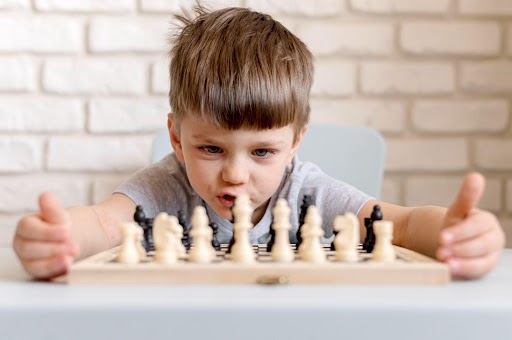
Watch two players of similar rating sit down for a game, and within ten moves you can often tell who’s going to win. It’s rarely about who knows more opening theory. It’s about who’s actually thinking, weighing options, spotting patterns, and planning several moves ahead while the other player reacts move by move. This is exactly the gap that advanced chess lessons are designed to close, moving a player beyond memorised sequences and into genuine strategic thinking.
Why Strong Players Think Differently
Club-level players and strong tournament players often know many of the same opening lines and basic tactics. What separates them is how they process a position once it leaves known territory. Strong players have trained themselves to ask better questions at the board: What does my opponent actually want here? Which pieces are doing the least work? What happens three moves from now if I commit to this plan? This shift, from reacting to planning, from memorising to understanding, is the real foundation of strategic chess.
Pattern Recognition Built Through Repetition
One of the clearest markers of a strong player is how quickly they recognise recurring structures: a weak pawn, an open file, a vulnerable king, a favourable minor piece trade. This recognition isn’t innate talent; it’s built through repeated exposure to thousands of positions, studied deliberately rather than played casually.
A few habits build this skill effectively:
- Reviewing annotated master games, focusing on why strong moves were chosen, not just what they were.
- Solving structured puzzles regularly, training the eye to spot tactical and positional patterns quickly.
- Analysing your own games afterward, identifying moments where a pattern was missed or misjudged.
Over time, this repetition compresses what used to take minutes of calculation into something closer to instant recognition.
Calculating With Purpose, Not Just Depth
Many improving players believe calculation is purely about looking further ahead. In reality, strong players calculate with purpose, they identify candidate moves first, then calculate only the lines worth exploring, rather than brute-forcing every possibility.
This selective calculation depends on:
- Evaluating the position first, understanding what each side needs before searching for moves.
- Narrowing candidate moves early, discarding options that clearly don’t serve the position’s demands.
- Calculating concrete lines only where necessary, saving mental energy for genuinely critical moments.
This is a skill rarely developed through casual play alone. It’s exactly the kind of structured thinking built through advanced chess lessons, where instructors walk students through the reasoning behind candidate move selection, not just the final answer.
Planning Around Imbalances
Strong players don’t just react to threats; they identify imbalances, differences in pawn structure, piece activity, king safety, or material, and build plans around exploiting them. A bishop pair, a weak pawn, a cramped opponent, these aren’t just observations, they’re starting points for a concrete plan.
Learning to spot and act on imbalances typically involves:
- Comparing both sides’ pawn structures for weaknesses or strengths.
- Assessing piece activity rather than just material count.
- Considering long-term factors like king safety alongside short-term tactics.
- Formulating a plan that addresses the position’s specific imbalances, rather than a generic strategy.
This kind of thinking takes longer to develop than memorising an opening repertoire, but it pays off across every stage of the game, not just the one line you happened to prepare.
Managing the Clock and Emotional Discipline
Strategic thinking isn’t purely analytical. Strong players also manage their own psychology under pressure: staying calm after a mistake, avoiding panic in time trouble, and resisting the urge to force a win when a position calls for patience instead. This discipline develops through experience, particularly tournament experience, but structured coaching accelerates it considerably by teaching players to recognise their own patterns of hesitation or impulsiveness before they cost a game.
Why Structured Learning Outperforms Self-Study Alone
Self-study has real value, but it has a ceiling. Without outside feedback, players often repeat the same conceptual mistakes for years without realising it. A coach or structured curriculum identifies these blind spots directly, correcting habits that self-study alone rarely catches.
This is where genuinely strong chess classes make a measurable difference, not by handing over more opening lines, but by training the thinking process itself: evaluation, planning, calculation, and emotional control, together, as a single integrated skill rather than separate topics studied in isolation.
Building the Habit of Reflection
One underrated skill among strong players is honest post-game reflection. Reviewing a loss without ego, asking what specifically went wrong, a misjudged plan, a missed tactic, poor time management, turns every game into a genuine learning opportunity rather than just a result to move past quickly.
A simple post-game review routine might include:
- Identifying the critical moment where the game’s direction changed
- Checking whether your evaluation of the position was accurate at that point
- Comparing your chosen plan against stronger alternatives
- Noting one specific, actionable lesson to carry into future games
Players who build this habit consistently tend to improve faster than those who simply play more games without ever revisiting them critically.
Conclusion
Strong chess players aren’t defined by how many moves they’ve memorised, but by how they think: recognising patterns, calculating with purpose, planning around imbalances, and staying composed under pressure. These skills take deliberate practice and honest feedback to build properly. For players ready to move beyond casual improvement, enrolling in online advanced chess classes in USA offers the structured guidance needed to develop genuine strategic thinking, the kind that separates strong players from everyone else at the board.
ChessBrainz is a leading online chess academy with 150+ FIDE-rated instructors teaching students across 50+ countries. Its curriculum, designed by Grandmasters, builds strategic thinking through structured evaluation and calculation training, helping advanced players move beyond memorised lines toward genuine, independent decision-making at the board.