
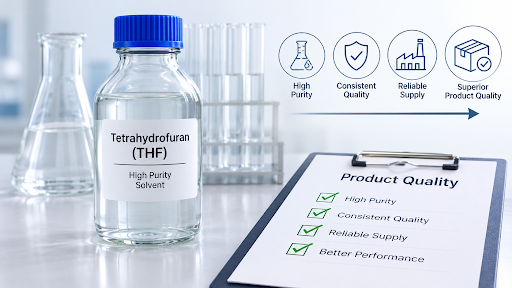
In chemical manufacturing, procurement decisions extend well beyond price per litre. The choice of Tetrahydrofuran THF Suppliers directly determines whether a downstream production process achieves consistent output quality, regulatory compliance, and operational safety — or spends months chasing contamination issues, peroxide formation incidents, and batch-to-batch variability that nobody can trace to a root cause. THF is one of those solvents that looks simple on a specification sheet and reveals its complexity only after the wrong supplier has been onboarded.
Working with a Trusted Tetrahydrofuran THF Supplier is not a procurement preference — it is an engineering decision with measurable consequences for yield, product stability, and long-term customer retention.
What Is Tetrahydrofuran (THF)?
Tetrahydrofuran, commonly referred to as THF, is a cyclic ether with the molecular formula C₄H₈O and CAS number 109-99-9. It is a colourless, water-miscible liquid with a characteristic ether-like odour, low viscosity, and broad solvency capability across a wide range of polar and moderately non-polar compounds.
Key physical and chemical properties of THF:
- Molecular weight: 72.11 g/mol
- Boiling point: 66°C at 1 atm
- Melting point: -108.4°C
- Flash point: -14.5°C (highly flammable)
- Density: 0.889 g/cm³ at 20°C
- Water solubility: Fully miscible
- Vapour pressure: 143 mmHg at 20°C
- Refractive index: 1.407 at 20°C
- Autoignition temperature: 321°C
THF is characterised as a polar aprotic solvent, which means it dissolves polar compounds effectively without donating protons — a critical property for reactions requiring anhydrous, nucleophile-compatible solvent environments. Its cyclic structure prevents the self-association seen in protic solvents and contributes to its distinctive solvation behaviour with polymer chains, resin systems, and pharmaceutical intermediates.
One important handling property that any competent Tetrahydrofuran THF Suppliers should communicate clearly is the tendency of THF to form explosive peroxides on prolonged exposure to oxygen and light. Unstabilised THF is a significant safety risk; commercial grades are therefore supplied with inhibitors — typically BHT (butylated hydroxytoluene) at 250 ppm — and must be stored away from oxidising agents, heat sources, and direct light in containers maintained under inert atmosphere.
Industrial Applications Of THF
THF’s combination of solvency power, moderate polarity, and compatibility with water and organic systems makes it indispensable across a wide range of industrial sectors. The Industrial THF suppliers who serve these markets understand that each application sector has different purity thresholds, inhibitor level requirements, and handling constraints — and supplying without this context produces field complaints that trace back to specification mismatches.
- Polymer Science And PVC Adhesives
THF is the primary industrial solvent for dissolving polyvinyl chloride (PVC) and is the active ingredient in PVC pipe cement and adhesive formulations. It dissolves PVC rapidly at room temperature, producing a homogeneous solution that creates a chemical weld at joint interfaces when applied. For PVC adhesive applications, water content below 300 ppm is typically specified — residual water causes incomplete PVC dissolution and adhesive cloudiness that signals formulation instability.
- Pharmaceutical Synthesis And API Manufacture
In pharmaceutical manufacturing, THF serves as a reaction solvent for Grignard reactions, lithiation reactions, and asymmetric synthesis sequences where its coordinating ability with metal centres — particularly lithium — makes it the solvent of choice over alternatives. For API synthesis under ICH Q3C guidelines, pharmaceutical-grade THF must meet strict peroxide level specifications (typically below 0.001% peroxide calculated as H₂O₂) because peroxide contamination at the reaction stage introduces oxidative impurities into the API that cannot be easily removed downstream. High-quality Tetrahydrofuran THF Suppliers for pharmaceutical supply chains maintain CoA records covering residual solvent content, peroxide value, water content by Karl Fischer titration, and GC purity with individual impurity profiles.
- Polyurethane And Spandex Fibre Production
THF polymerises under acid catalysis to form polytetramethylene ether glycol (PTMEG), the polyol backbone used in elastomeric polyurethanes and spandex (Lycra) fibres. This is the single largest industrial consumption pathway for THF globally, and the THF entering this process must meet tight specifications for unsaturates, aldehydes, and water content — impurities in THF carry through into PTMEG molecular weight distribution and produce off-specification elastomer with reduced tensile strength and elongation.
- Coatings, Resins, And Adhesives
Cellulose acetate, polyacrylates, polyurethane coatings, and vinyl resins are solubilised in THF for application in surface coatings, printing inks, and adhesive systems. THF’s low boiling point (66°C) makes it a fast-evaporating solvent that aids coating film formation, but this same property requires that solvent recovery systems operate efficiently — Industrial THF suppliers who support coatings sector customers typically provide technical data on evaporation rate relative to n-butyl acetate (approximately 6.3) and solubility parameter (18.6 MPa½) to assist in formulation design.
- Gel Permeation Chromatography (GPC) And Laboratory Use
THF is the standard mobile phase solvent for GPC analysis of synthetic polymers — dissolving the polymer sample, carrying it through the column, and providing a stable baseline with refractive index detection. HPLC-grade THF for this application requires UV transparency above 230 nm, peroxide content below 5 ppm, and water below 50 ppm to prevent column degradation and baseline drift.
Key Differences: Reliable THF Suppliers Vs Unreliable Ones
The gap between high-quality tetrahydrofuran (THF suppliers for industries and commodity distributors is not visible in the headline specification — most suppliers can quote 99% minimum purity. It becomes visible in peroxide control, batch-to-batch consistency, documentation quality, and responsiveness when a field issue arises.
| Quality Parameter | Reliable THF Supplier | Unreliable THF Supplier |
| Purity (GC) | ≥99.9% with individual impurity profile | ≥99% headline figure only |
| Water content (KF) | <100 ppm (pharma grade) / <300 ppm (industrial) | Not routinely tested |
| Peroxide value | <0.001% (pharma) / <0.003% (industrial), tested per batch | Tested occasionally or not at all |
| Inhibitor level (BHT) | 250 ±50 ppm, documented on CoA | Unknown or inconsistent |
| Batch traceability | Full lot-to-lot CoA with GC chromatogram | Generic certificate without batch linkage |
| Storage compliance | Temperature-controlled, inert atmosphere, light-protected | Ambient open drum storage |
| Regulatory support | REACH, SDS, ICH Q3C data available | SDS available; other documentation on request only |
| Peroxide test on dispatch | Tested within 48 hours of shipment | Tested at manufacture, not at point of dispatch |
The peroxide test-on-dispatch point is the one most consistently overlooked. THF peroxide levels increase during storage, especially in partially emptied containers where the headspace oxygen exposure accelerates formation. A supplier who tests at manufacture and ships six weeks later without a re-test is delivering a product whose peroxide content at point of use may be 3–5× the value on the certificate — a safety and quality risk that the end user discovers only when the batch has already entered the process.
Why Purity Grade Selection Matters Before Procurement
Different THF purity grades exist for legitimate reasons — and matching the grade to the application is one of the Benefits of reliable Tetrahydrofuran THF suppliers that goes beyond the material itself.
Technical / Industrial Grade (≥99.0%): Suitable for PVC adhesives, coatings, and non-pharmaceutical solvent applications where trace impurities at the 0.1–0.5% level are tolerable in the finished product. Lower cost, wider inhibitor level tolerance.
Purified / Anhydrous Grade (≥99.5–99.9%): Required for polymerisation reactions, Grignard chemistry, and lithiation sequences where water and protic impurities interfere with organometallic reagents. Water content specified at <30 ppm; often packaged under nitrogen in sealed containers.
HPLC / Spectroscopic Grade: Ultra-low UV-absorbing impurities, peroxide below 5 ppm, high batch consistency. For analytical and chromatographic applications.
Pharmaceutical Grade (≥99.9%, ICH Q3C compliant): Full residual solvent test suite, peroxide below 0.001%, heavy metals tested, full batch traceability documentation. For API synthesis under GMP.
Specifying industrial grade for a pharmaceutical synthesis application — because the headline purity number is the same — is a compliance failure waiting to materialise at the next regulatory audit. The Benefits of reliable Tetrahydrofuran THF suppliers include the technical guidance to prevent this kind of mismatch before the purchase order is raised, not after the product has failed incoming QC.
How To Evaluate And Select The Right THF Supplier
Selecting the right Tetrahydrofuran THF Suppliers requires a structured evaluation that goes past price comparison and into process understanding. The following criteria form the basis of a sound supplier qualification:
Documentation And Traceability
Request a complete Certificate of Analysis for the proposed supply grade, covering GC purity with individual impurity listing, water content (KF method), peroxide value (iodometric titration or photometric), inhibitor level, and colour (APHA). The CoA should carry a batch number that links to manufacturing records at the supplier’s facility — not a generic grade specification sheet reissued for each order.
Testing Protocol And Freshness
Confirm whether peroxide testing is performed at the time of dispatch rather than at the time of manufacture. For pharmaceutical and polymerisation applications, request a certificate stating the test date alongside the shipment date.
Storage And Handling Infrastructure
A credible Tetrahydrofuran THF Suppliers maintains THF in temperature-controlled, sealed, inert-atmosphere storage away from oxidising agents and ignition sources. Ask specifically about container type (nitrogen-blanketed drums, IBCs, or ISO tanks), maximum storage temperature, and the supplier’s protocol for partially used containers.
Regulatory And Safety Support
Verify availability of current SDS, REACH registration data (for European supply chains), and — for pharmaceutical customers — ICH Q3C classification documentation. High-quality Tetrahydrofuran THF suppliers for industries support their customers through regulatory submissions, not just product delivery.
Supply Reliability And Lead Time Transparency
Evaluate the supplier’s inventory position, minimum order quantity, and typical lead time against the buyer’s consumption pattern. THF has a practical shelf life of 12 months from manufacture in properly maintained conditions — a supplier with long inventory cycles increases the risk of receiving material with elevated peroxide levels even before the shelf life has technically expired.
Vastani Chemicals Limited, established in 2002 and headquartered in Mumbai with manufacturing at Ankleshwar and Rajkot in Gujarat, operates as a manufacturer and supplier of industrial solvents and specialty chemicals — including THF and related cyclic ether products — with a combined consented production capacity of 5,000 MTPA and a supply network covering customers across India and international markets, bringing the traceability, infrastructure, and technical support infrastructure that serious Tetrahydrofuran THF Suppliers must deliver.
Conclusion
Tetrahydrofuran is not a commodity solvent in any application where output quality, process safety, or regulatory compliance is a business requirement. The purity grade, peroxide management practice, inhibitor level consistency, and documentation discipline of the chosen Tetrahydrofuran THF Suppliers propagate directly into the quality of the finished product — whether that product is a pharmaceutical intermediate, an elastomeric polyurethane, a PVC pipe joint, or a polymer molecular weight distribution result.
The Benefits of reliable Tetrahydrofuran THF suppliers are not abstract: fewer batch failures, lower rework costs, cleaner regulatory audits, and a supply chain that responds with technical clarity when a field issue arises rather than deflecting to SDS language. Procurement teams that evaluate Tetrahydrofuran THF Suppliers on purity headline numbers and unit price alone are optimising for the wrong variable. The right evaluation accounts for what happens between the CoA and the reactor — and that is entirely a function of who supplied the solvent and how they managed it before it left their facility.