
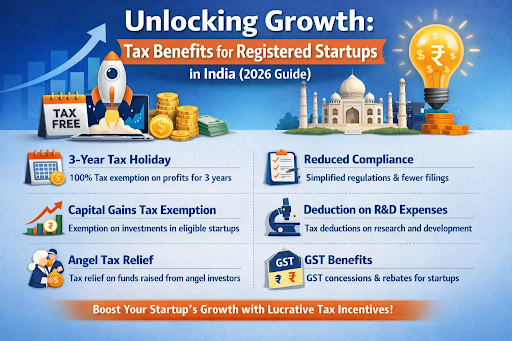
Launching a startup in India is an exhilarating journey, filled with ambition and innovation. In 2026, the ecosystem is more mature than ever, but the fundamental question for founders remains: “Do startups get tax benefits after registration?”
The short answer is a resounding YES. The Government of India, through its ‘Startup India’ initiative, offers substantial tax holidays and exemptions specifically designed to help early-stage ventures survive the crucial first few years and reinvest profits for growth.
However, just completing your basic pvt ltd company registration in india isn’t enough to unlock these benefits automatically. You must navigate a specific certification process.
This blog breaks down exactly which tax benefits are available and how you can access them.
The Two Levels of Recognition: Incorporate vs. DPIIT Certified
To understand the tax benefits, it’s vital to distinguish between two steps:
- Incorporation: Registering your business (e.g., as a Pvt Ltd, LLP, or Partnership) with the Ministry of Corporate Affairs (MCA). This makes you a legal entity.
- DPIIT Recognition: Getting certified by the Department for Promotion of Industry and Internal Trade (DPIIT) specifically as an “innovative startup.”
CRITICAL NOTE: Standard startup registration services usually cover Step 1 (Incorporation). The full spectrum of tax benefits is only available once you achieve Step 2 (DPIIT Recognition).
[Image comparing simple incorporation vs. DPIIT certified startup]
Major Tax Benefits Available to DPIIT Recognized Startups (2026)
Once your startup is recognized by DPIIT, it unlocks several game-changing fiscal advantages:
1. The 3-Year Income Tax Holiday (Section 80-IAC)
This is the most sought-after benefit.
- The Benefit: Recognized startups can claim a 100% tax exemption on profits for three consecutive financial years out of their first ten years since incorporation.
- The Intent: This holiday is designed to help startups retain capital during their crucial growth phase, allowing them to reinvest in scaling operations, research, and development.
- Accessing It: After receiving DPIIT recognition, the startup must apply to the Inter-Ministerial Board (IMB) for this specific tax certificate.
2. Exemption from Angel Tax (Section 56(2)(viib))
Angel Tax has historically been a significant pain point for founders raising capital.
- The Benefit: DPIIT-recognized startups are exempt from the provisions of Angel Tax when they issue shares to investors (both residents and non-residents) at a premium exceeding the fair market value.
- The Intent: This exemption facilitates easier fundraising without investors worrying about tax implications on their seed and angel investments.
3. Relaxed Norms for Carry Forward of Losses (Section 79)
Startups, especially in the early stages, often operate at a loss.
- The Benefit: Startups can carry forward and set off their eligible operational losses against future profits, even if there is a substantial change in the voting power or shareholding (exceeding 51%) of the company, provided the losses were incurred during the 7 years from incorporation.
- The Intent: This acknowledges the pivot and dilution of shares common in the startup growth curve.
Key Eligibility Criteria for Tax Benefits (DPIIT + IMB)
To claim these significant tax advantages in 2026, your entity must meet specific criteria defined by the ‘Startup India’ guidelines:
DPIIT Recognition Checklist:
- Entity Type: Must be incorporated as a Private Limited Company (Pvt Ltd), a Registered Partnership, or a Limited Liability Partnership (LLP). This is why many choose pvt ltd company registration in india for credibility.
- Age of Entity: Must not exceed 10 years from its date of incorporation/registration.
- Turnover: The annual turnover must not exceed ₹100 Crores in any financial year since incorporation.
- Nature of Work: The entity must be working towards innovation, development, improvement, or commercialization of products, services, or processes. It should be a ‘start-up’—not just a new version of an existing business structure.
Inter-Ministerial Board (IMB) Certification (for the 3-Year Tax Holiday):
While DPIIT recognition unlocks exemptions like Angel Tax, the IMB reviews applications specifically for the 3-year income tax holiday, assessing the startup’s innovative nature more rigorously.
Steps to Avail the Tax Benefits
Step 1: Incorporate Your Entity
Start by formalizing your business structure (e.g., getting a Pvt Ltd registration).
Step 2: Apply for DPIIT Recognition
Register on the Startup India portal and submit the application for DPIIT recognition, detailing your innovation and business model.
Step 3: Apply for Tax Exemption Certificates (IMB & Others)
Once recognized by DPIIT, use the same portal to apply for the specific tax exemptions you require (e.g., Applying for IMB certification for the Section 80-IAC profit-linked deduction).
Leverage Professional Startup Registration Services
Navigating the DPIIT recognition and IMB certification process can be complex and demanding, requiring meticulous documentation. Utilizing specialized startup registration services can streamline this journey. These experts help:
- Assess Eligibility: Ensure your business model meets the innovation criteria defined by DPIIT.
- Draft Compelling Applications: Properly present your innovation to the regulatory boards.
- Manage Documentation: Handle all regulatory filings for both incorporation and recognition.
- Provide Compliance Advisory: Guidance on maintaining eligibility and ongoing compliance.
Conclusion
Yes, startups absolutely get substantial tax benefits in 2026. However, these benefits are structured incentives for innovation, not universal entitlements. By completing your pvt ltd company registration in india and subsequently achieving DPIIT recognition, you unlock significant fiscal runway to accelerate your startup’s growth.
Is your startup ready for significant growth and investor interest?
I can help you analyze if your business model qualifies for the crucial DPIIT recognition and the IMB tax holiday. Would you like me to generate an eligibility assessment based on your startup’s key details?