
Industrial machinery does not fail loudly at first. It starts with vibration, heat, misalignment, and microscopic wear that goes unnoticed until downtime becomes unavoidable. Bearing housings sit at the centre of this silent failure chain. Among them, pillow block bearings and plummer blocks are often discussed as if they are interchangeable. They are not. Treating them as equivalents is one of the most common and costly engineering mistakes seen across production floors, processing plants, and heavy industries.
This article cuts through terminology confusion and purchasing shortcuts to explain the real, practical differences—based on how these units behave under load, over time, and inside actual industrial environments.
What These Units Are Designed to Solve
Every bearing housing exists for a reason: to keep a rotating shaft stable while managing load, heat, contamination, and alignment drift. Pillow block bearings and plummer blocks approach this problem from very different design philosophies.
Pillow Block Bearings: Standardisation Over Complexity
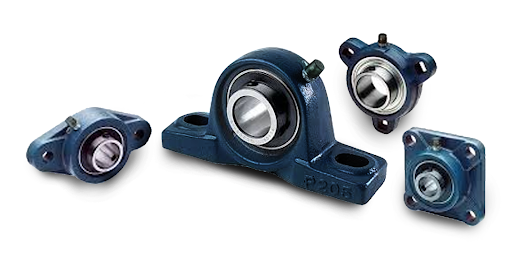
Pillow block bearings are factory-assembled units where the bearing insert and housing are supplied as one component. The housing is solid, compact, and designed to be bolted directly onto a flat surface. The primary objective is speed—fast installation, minimal setup, and predictable performance under controlled conditions.
These units dominate light-to-medium duty machinery because they remove decision-making from the installation process. Shaft height, bearing seating, and housing geometry are already fixed. That convenience, however, comes with limits.
Plummer Blocks: Engineering for Variability and Abuse
Plummer blocks are built around uncertainty—uncertain loads, uncertain alignment, uncertain contamination levels. The split housing design allows the bearing to be mounted, inspected, and replaced without disturbing the shaft. This alone changes how maintenance strategies are built around large equipment.
These housings are not optimised for speed of installation. They are optimised for survival in environments where machinery is expected to run continuously, often under punishment.
Housing Construction and Mechanical Consequences
Design decisions made at the casting stage determine how a bearing behaves years later.
Solid Housing vs Split Housing Reality
Pillow block bearings use a single-piece housing. This limits internal access but improves rigidity for moderate loads. The housing geometry is compact, which works well for smaller shafts and lower bending moments.
Plummer blocks use a split housing—base and cap. This allows controlled clamping of the bearing and better distribution of load across the seating surface. The result is lower stress concentration, especially under shock loads or fluctuating forces.
Material Thickness and Structural Margin
Pillow block housings are lighter by design. That is not a flaw; it is intentional. Excess material adds cost and serves no purpose in stable operating conditions.
Plummer blocks are heavier because mass matters. Increased wall thickness improves vibration damping and resists deformation when loads spike unexpectedly.
Load Handling Is Where the Gap Widens
Most bearing failures traced back to housing selection are load-related, not bearing-related.
Radial Load Behaviour
Pillow block bearings handle radial loads efficiently when those loads remain within a predictable range. Once loads become uneven, cyclic, or impact-driven, housing distortion and insert movement begin to shorten service life.
Plummer blocks are engineered for heavy radial loads, particularly on long shafts where bending moments increase away from the drive end. The housing supports the bearing rather than merely containing it.
Axial Load Management
Axial load capacity in pillow block units is limited by locking mechanisms such as set screws or eccentric collars. These systems are not designed for sustained thrust loads.
Plummer blocks allow bearing selection that accommodates axial displacement or axial fixing, depending on system requirements. This flexibility prevents thermal expansion from turning into bearing preload.
Alignment, Shaft Behaviour, and Thermal Expansion
Machines rarely stay aligned once they start running.
Misalignment Tolerance
Pillow block bearings offer limited misalignment accommodation. Minor shaft deviation can be absorbed, but persistent misalignment accelerates wear.
Plummer blocks commonly house spherical roller bearings, which tolerate angular misalignment without transferring stress to the housing or shaft.
Thermal Growth Reality
As shafts heat up, they grow. Short shafts grow little. Long shafts grow enough to destroy bearings if not accounted for.
Pillow block units struggle in long-shaft applications because axial movement options are restricted.
Plummer blocks are selected in fixed and non-fixed arrangements, allowing controlled axial movement without compromising bearing integrity.
Lubrication and Contamination Control
Bearing life is dictated less by load rating and more by lubrication quality.
Sealing Capability
Pillow block bearings are usually supplied with contact seals or basic labyrinth designs. These work well in clean or semi-clean environments.
Plummer blocks support advanced sealing systems capable of surviving dust, moisture, scale, and abrasive particles. This alone explains their dominance in mining, cement, and steel plants.
Lubrication Strategy
Pillow block units are grease-focused and often rely on periodic manual relubrication.
Plummer blocks integrate easily with centralised lubrication systems, oil bath lubrication, or circulating oil setups—critical for high-speed or high-temperature applications.
Installation Speed vs Maintenance Reality
Short-term convenience often masks long-term cost.
Installation Perspective
Pillow block bearings install quickly. Bolt down, align shaft, tighten locking mechanism, and run. This simplicity suits production environments where changeovers are frequent.
Plummer blocks require more careful installation but reward that effort with predictable behaviour over extended service intervals.
Maintenance Access
Replacing a pillow block bearing often means removing the shaft or dismantling surrounding equipment.
Plummer blocks allow bearing inspection and replacement by removing the cap alone. In large installations, this difference saves days of downtime annually.
Cost Is Not What the Purchase Order Shows
Procurement decisions often focus on unit price. Engineering reality focuses on lifecycle cost.
Pillow block bearings cost less upfront and make financial sense in controlled environments.
Plummer blocks cost more initially but reduce long-term expenditure by extending bearing life, reducing maintenance labour, and preventing secondary damage to shafts and housings.
Where Each Option Makes Sense
Correct selection is not about preference; it is about operating truth.
Pillow block bearings belong in:
- Light and medium-duty machinery
- Short shafts with stable alignment
- Clean production environments
- Applications prioritising fast replacement
Plummer blocks belong in:
- Heavy rotating equipment
- Long shafts and high inertia systems
- Dirty, abrasive, or high-temperature environments
- Installations where downtime carries major cost
The Bottom Line That Actually Matters
Confusing pillow block bearings with plummer blocks is not a terminology issue; it is an engineering risk. One is built for speed and simplicity. The other is built for endurance and punishment. Selecting the wrong housing rarely causes immediate failure, which is why the mistake is repeated so often. Damage accumulates quietly until the system reaches a breaking point.
Bearing housings do not add value by themselves. They protect value already invested in shafts, motors, gearboxes, and production uptime. Choosing between pillow block bearings and plummer blocks is not about what fits on the drawing—it is about what survives in the real operating world.