
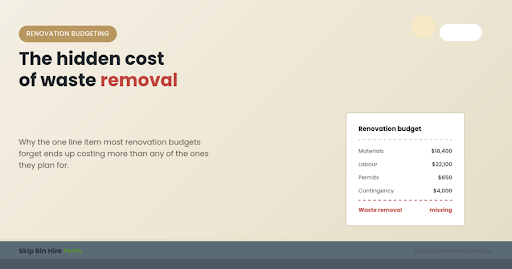
Ask most homeowners to break down a renovation budget, and the categories come out fast. Materials, labour, permits, a contingency buffer for the unexpected. Waste removal rarely makes that list at all. It’s treated as a minor detail that will sort itself out somewhere along the way, not a real cost centre worth planning for.
That gap is where a surprising number of renovation projects quietly go over budget, not through one big expense, but through a string of small, unplanned costs that all trace back to the same blind spot.
Why Waste Removal Gets Left Off the Budget
Most budgeting habits are built around things that get quoted upfront. A tiler gives a price. A supplier gives a delivery cost. Waste removal doesn’t fit that pattern as neatly, because the volume of rubbish a project produces is genuinely hard to estimate before the work starts.
That uncertainty leads a lot of people to simply skip the line item altogether, figuring they’ll deal with it as it comes up. The problem is that “dealing with it as it comes up” almost always ends up costing more than planning for it would have.
Where the Money Actually Leaks Out
The costs here are rarely dramatic on their own, which is exactly why they’re easy to miss until they’ve added up.
Multiple trips to a transfer station burn fuel and time that don’t show up on any invoice, but they’re real costs all the same, especially once you factor in a vehicle that isn’t really built for hauling debris. A rushed, last-minute skip bin booking, ordered after the mess has already piled up rather than planned in advance, often costs more than the same booking made with a bit of lead time. Undersized bins lead to a second booking altogether, effectively doubling a cost that could have been avoided with a slightly more accurate estimate from the start. And materials that could have been separated and recycled, but got mixed together because there was no system in place, sometimes mean paying general waste rates on material that could have gone through a cheaper stream.
None of these costs are large individually. Together, across a full renovation, they can add up to a meaningful chunk of a budget that was never accounted for.
The Real Cost Isn’t Just Financial
Money aside, poor waste planning tends to cost time too, and time on a renovation project has its own price tag, especially for anyone paying tradespeople by the day.
A site cluttered with debris slows everyone down. Tradespeople end up working around piles of rubbish instead of through a clear space, which eats into productive hours without ever showing up as a separate line item. A project that runs a few days longer because of blocked access or repeated tip runs doesn’t get logged as a “waste problem.” It just looks like the renovation took longer than expected, and the true cause often goes unnoticed entirely.
A Simple Fix: Treat Waste Like Any Other Budget Line
The projects that avoid this trap tend to do one thing differently. They estimate waste volume at the same stage they estimate materials, rather than leaving it as an afterthought to be sorted out once the mess has already built up.
That estimate doesn’t need to be precise. A rough sense of project type and scale, a kitchen strip-out, a bathroom renovation, a full home reno, is usually enough to land on a sensible bin size and a realistic cost, well before the first wall comes down.
Getting a quote for waste removal at the same time as quotes for materials and labour means it’s baked into the budget from day one, rather than surfacing as a surprise expense partway through. Providers like Skip Bin Hire Perth typically offer clear, upfront pricing across a range of bin sizes, which makes it straightforward to slot an accurate waste removal cost into a renovation budget from the outset rather than guessing at it later.
Booking Ahead Beats Booking in a Panic
There’s also a cost difference between planning ahead and scrambling once the rubbish has already piled up. A bin booked in advance, timed around when demolition or a major clean-up stage will actually happen, tends to be both cheaper and more efficient than one booked reactively once the mess has become unmanageable.
That’s worth factoring in for renovations happening anywhere across the Perth metro area, since delivery availability across different suburbs can affect how much lead time is worth building into a project schedule.
What This Means for the Next Renovation Budget
None of this requires a complicated spreadsheet. It just means treating waste removal as a genuine line item, estimated early, priced upfront, and booked with enough lead time to avoid a rushed, reactive decision later.
The renovations that stay on budget tend to share this habit more than any other single factor. They don’t leave waste as an afterthought, they plan for it the same way they plan for tiles, timber and trade labour, and by doing that, they avoid the quiet, compounding costs that catch so many other projects off guard.