
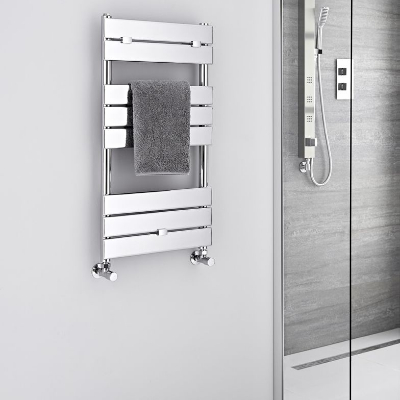
Hydronic Systems: Integrated Warmth Ecosystems
The hydronic towel warmers work by moving hot water that is supplied by the central boiler at home to the stainless steel rails, which run in airtight tubes. This passive design makes use of the plumbing network and uses radiators as towel warming surfaces. Their major strength is the ability to synchronize with the home heating schedule, heating the towels when boiler is turned on without use of extra energy. It needs professional integration in plumbing, but does not entail electrical wiring. The systems are most successful in full-home retrofits where bathrooms are already supplied by boilers and they provide near silent running and very little maintenance other than annual bleeding.
Electric Rails: Autonomous Thermal Precision
Electric heated towel rail operates as self-contained unit, having inside components to produce desired heat. It is free-standing, independent of central systems, and mounts in any location with power usual electrical access – perfect in retrofits, or stand-alone bathrooms. Newer units include programmable thermostats, wi-fi control, and sensors to heat only when wanted in order to do so as precisely as possible. As they use direct electricity they also have the advantage of improved efficiency via low-wattage designs (60-150W) and ceramic technology, which allows them to heat evenly without hot spots. Their flexibility to install like plug and play working environments is compatible with rented places or simple renovation.
Material Synergy: Stainless Steel’s Dual Dominance
The high-end hydronic towel warmers and electric heated towel rails systems are united in the stainless steel build. 304/316L alloys (marine-grade) are important in environments like the ones that have humid air because they are resistant to corrosion, yet they are able to sustain a structure under thermal loadings. Excellent thermal conductivity of the material takes the heat, may it be water or electrical, and makes its way into the towels. Brushed, polished, or matte finishes can be an aesthetic fit in any number of varied interior settings, where functional rails become minimalism statements.
Installation Realities: Space and System Constraints
- Hydronic requires proximity to hot water pipes and vertical clearance for air-venting valves. Retrofit projects may demand wall demolition for concealed plumbing.
- Electric needs only a nearby GFCI outlet but faces placement limitations in moisture-exposed zones without IP68-rated models.
Electric rails adapt better to compact spaces with slim vertical designs, while hydronic systems often require larger footprints for optimal water flow.
Operational Economics: Long-Term Value Analysis
Hydronic towel warmers have a lower operating cost in homes having efficient boilers; they present little energy load, as they use available hot water. Nevertheless, the electric heated towel rail units are superior in terms of control to minimize the consumption. Programmable systems allow running only in the morning/evening process of daily routine with ~0.5kWh per day consumption. With solar arrays they have a near-zero carbon footprint. The life cycle costs are in favor of hydronic in homes that are heated on a continuous basis and electric is economical in spaces that are sporadically in use.
Sustainability Through Engineering
Hydronic systems leverage renewable-ready boilers (geothermal, biomass) for net-zero operation. Electric models paired with green energy achieve similar eco-efficiency. Both systems utilize 100% recyclable stainless steel, though hydronic units avoid rare-earth elements found in electric heating components. Water-based hydronics maintain an edge in whole-home energy synergy, while smart electric rails excel in targeted, on-demand warmth.
Curating Comfort: Aligning Solutions with Spaces
Selecting between hydronic towel warmers and electric heated towel rail systems hinges on three dimensions:
- Architectural Context: New builds favor hydronic integration; retrofits lean electric
- Usage Patterns: Frequent users benefit from hydronic’s constant readiness; occasional bathers prefer electric’s scheduled precision
- Aesthetic Vision: Both offer design flexibility, though electric provides greater form diversity
Conclusion: Engineering Meets Artisanal Warmth
The ideal heated rail solution emerges not from universal superiority, but from harmonious alignment with a home’s infrastructure and inhabitants’ rituals. Hydronic towel warmers deliver seamless, whole-house efficiency for boiler-equipped residences. Electric heated towel rail units empower precise, independent comfort everywhere else. Both manifest the art of temperature craftsmanship – where engineered warmth becomes an enduring sensory signature in daily living.