
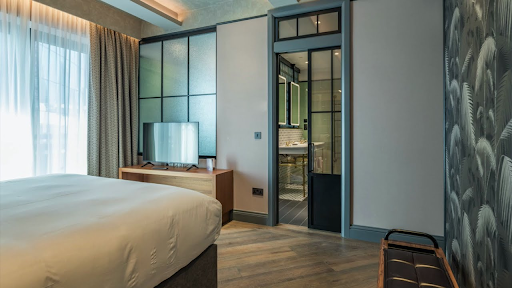
Most doors announce themselves. You see the hinges. You see the handle. You plan your movement around their swing. Even when closed, they feel separate from the wall that holds them. That separation shapes how we think about rooms, often without us realising it.
There is another way to treat a door. Not as an object placed into a space, but as a surface that temporarily changes function. When closed, it behaves like a wall. When open, it stops existing altogether. This shift alters how a room is perceived and used.
In interiors where visual calm matters, this distinction becomes important. Minimalist homes, gallery-like spaces, and modern renovations often aim to reduce visual noise. Too many lines, breaks, and moving parts can make a room feel restless. Traditional doors contribute more to this than most people expect.
When a door slides away into the structure, the wall regains continuity. Sightlines lengthen. Corners feel cleaner. The room reads as simpler, even if nothing else has changed. This is not about hiding functionality. It is about integrating it.
Architects often think in planes rather than objects. Floors, walls, ceilings. Anything that interrupts those planes draws attention. Hinged doors interrupt constantly, even when doing nothing. In contrast, sliding pocket doors allow the plane to remain intact whenever the door is not required.
This approach is especially effective in transitional areas. Hallways that connect private and shared spaces. Pass-through rooms that are neither fully open nor fully closed. These zones benefit from doors that can appear and disappear without altering the character of the space.
The effect is subtle but cumulative. Rooms feel more deliberate. Less pieced together. The architecture leads, rather than the fittings. Furniture placement becomes easier because walls behave predictably. Art and lighting can be positioned without accounting for door arcs.
There is also a tactile quality to consider. Pocketed doors tend to be used more intentionally. Because they do not hover in the room, people open and close them with purpose. The action feels quieter, more deliberate, almost architectural rather than mechanical. Movement becomes a choice rather than a reaction, and that subtle difference affects how people relate to the space over time.
This does not mean the door lacks presence. When closed, it defines a boundary clearly. Privacy is not compromised. What changes is the way that boundary is expressed. Instead of protruding into the room, it holds the line of the wall. The boundary feels drawn rather than imposed, which makes the transition between spaces feel more natural.
Material choice amplifies this effect. Flush panels, concealed tracks, and minimal hardware strengthen the illusion of continuity. Even more expressive finishes, when aligned carefully, still read as part of the wall rather than an added element. The door participates in the surface instead of interrupting it.
Of course, this integration demands planning. Wall thickness, internal obstructions, and construction sequencing matter. Retrofitting can be more complex than surface-mounted alternatives. But the payoff is not novelty. It is coherence. The door does not ask for attention. It supports the room quietly.
Homes that feel thoughtfully designed often share this quality. Components do not compete for attention. They support the overall spatial idea. Doors stop being interruptions and start behaving like part of the architecture itself, reinforcing calm rather than breaking it.
This is where sliding pocket doors quietly excel. They are not trying to be invisible as a trick. They are invisible because, when not in use, they are no longer asking the room to accommodate them.
In spaces where calm, clarity, and continuity matter, the most powerful design moves are often the ones that remove rather than add. When a door becomes part of the wall, the room finally gets to speak for itself.