
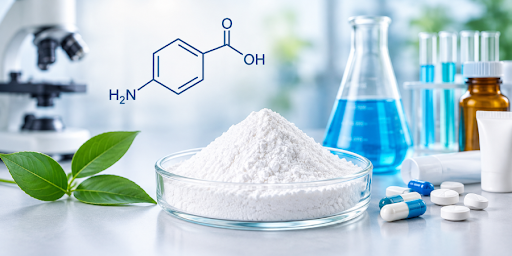
Para amino benzoic acid (PABA) An organic chemical that is widely used in the industrial and scientific fields Para amino benzoic acid consists of amino and carboxyl groups attached to the benzene ring. This influences the physical and chemical properties and to some degree the uses of para amino benzoic acid. Para amino benzoic acid is used to produce certain chemicals, as well as a component of the biological pathways of some microorganisms and has been used as a sunscreen ingredient to absorb the suns UV rays but is less used today as it can sensitise the skin.
What Is Para Amino Benzoic Acid
Para amino benzoic acid is one of the organic compounds called Aminobenzoic acids that have aromatic properties. It has a benzene ring as the carbon skeleton with an amino group and a carboxylic acid group in the opposite positions.
It is known as PABA and has the molecular formula C₇H₇NO₂. This material is used as a synthetic intermediate for chemical manufacturing and has several applications in the research, pharmaceutical and industrial markets.
Some basic data about para amino benzoic acid:
Chemical name: 4 Aminobenzoic acid.
Common abbreviation: PABA.
Molecular formula: C₇H₇NO₂.
Molar mass: Approximately 137.14 g/mol.
Chemical family: Aromatic carboxylic acids.
These characteristics can also be used to define how para-amino benzoic acid is going to react with other chemicals and the areas that it can be used in.
Chemical Properties of Para Amino Benzoic Acid
The structure of para-amino benzoic acid gives it different chemical properties. Its amino group will participate in various reactions involved in the formation of other compounds. It will also undergo reactions involving its carboxylic acid group involved in synthesis of compounds.
Important chemical properties include:
It takes place from a benzene ring that has a steady chemical structure.
Amino group: Can undergo many chemical reactions.
Molecular formula: C₇H₇NO₂ identifies its composition.
Chemical reactivity: the group’s functions can be used as an intermediate in the synthesis of other chemicals.
These qualities enable the para-amino benzoic acid to be leveraged in laboratories and sectors. But whether it can be used is governed by the conditions of the reaction, the purity required and the use intended.
Physical Properties of PABA
Physical appearance indicates the way of the compound prepared and storing to final producers and users. Method Para amino benzoic acid is the crystalline powder, white to off white in color.
Its main physical properties include:
Arrival: White or nearly white crystalline powder.
Molecular weight: Around 137.14 g/mol.
Solubility: Slightly soluble in cold water, at which a temperature and pH dependence of the solubility have been observed.
Melting behaviour: It melts at high temperature. If we take a look at the melting temperature, it is reported at about 186-189°C.
Storage: It must be stored in a proper tightly closed container according to its safety data sheet.
When deciding to use para-amino benzoic acid these properties should be taken into account for its handling, storage and formulation. It is essential for the makers to always verify the technical data sheet of para-amino benzoic acid with the supplier.
How Does Para Amino Benzoic Acid Work in Chemical Processes
The para-amino benzoic acid gets its properties from chemical activity of amino and carboxyl acid groups. These groups make it possible for the compound to undergo chemical reactions with some specific chemicals and result in some products.
For example, PABA can be the raw material used by the manufacturer when choosing compounds with specific chemical structures. It is their product that will depend on the other ingredients, conditions and manufacturing process.
Its functions can encompass:
- Supporting the synthesis of selected organic compounds.
- Providing a starting structure for chemical modifications.
- Aiding researchers in the development of aromatic compounds and their reactions.
- Supporting certain industrial and pharmaceutical research processes.
If the reaction conditions are not correct you may need to change the reaction conditions if possible. The following requirements should be carefully checked Product quality.
Common Uses of Para Amino Benzoic Acid
Para amino benzoic acid has a lot of applications in chemical research and processing. It can be used for a variety of applications based on the purity of and its various grades.
Some common uses include:
Chemical synthesis: It is used as a starting material for the synthesis of certain organic compounds.
Pharmaceutical research: This is used by the researchers in the case of studies related to chemical structures and synthesis.
Manufactures in industry: Is a possible intermediary in certain manufacturing procedures.
Microbiology: Some pathogens synthesise PABA as part of their own biochemical pathways in order to make their own folates.
Laboratory research: It is employed to study chemical reactions as well as aromatic compounds’ behaviour.
Certain grades of PABA are not suitable for all requirements. Prior to ordering the material, the customer must make sure the characteristics of the product are suitable to the intended purpose.
Para Amino Benzoic Acid in Sunscreen and Cosmetology
Para amino benzoic acid was once used as an active compound in some sunscreens. It has the ability to absorb some types of ultraviolet radiation, particularly UVB rays. This made it an effective way to protect your skin from UV exposure.
In the past PABA was more widely used in many sunscreens. Over time PABA has become used less due to skin irritation and allergic contact dermatitis from those with sensitive skin and the potential for staining of clothing.
Key information regarding its use as a beauty product:
- Formerly contained in some older sunscreens.
- It absorbs certain UVB wavelengths.
- Some people may experience skin sensitivity.
- Its application within sunscreen products is subject to regulations.
- Other UV filters approved for use in sunscreens.
Para amino benzoic acid is not necessarily a cosmetic material. Producers should verify regulations, present safety standards and formulation principles for safe inclusion of parabenzoyl benzoic acid.
Biological Role of PABA
Para amino benzoic acid is used as an important component of folate production by some microorganisms. Folate also known as vitamin B9 plays a role in all of these activities as well as the manufacturing of building blocks of DNA.
Certain microorganisms, including some bacteria, synthesize the precursor, PABA, in their folate synthesis pathway. The cells convert this chemical by way of a number of enzyme-controlled steps to the compounds required to make folate.
Its biological importance includes:
- Supporting folate biosynthesis in certain microorganisms.
- Helping researchers understand microbial metabolic pathways.
- As a subject of medicine in microbiology and biochemical research.
- Assisting scientists in studying the way microorganisms produce vital compounds.
But that is not how PABA is used to synthesize folate in humans. Humans must find our source of folate through either our diet or through taking a supplement. Para amino benzoic acid should not be labeled an essential human vitamin.
Industrial and Pharmaceutical Applications
Para amino benzoic acid has the potential to be helpful in a limited extent to the industrial and pharmaceutical research processes with certain processes as a result of its molecular structure. Its functional groups enable it to undergo chemical reactions.
Potential applications include:
Pharmaceutical research: This may be the reason your chemist may use this in the process of developing or studying chemical compounds.
Specialty chemicals: It may be used in the manufacturing of multiple chemical products.
Testing and experimentation: New formulations can be tested with its reactions and potential uses.
It provides the means for the microbiologists to study folate pathways of microorganisms. Depending on the type of process and the quality level to be met, their use will differ. Prior to settling on para amino benzoic acid the organizations can confirm the fresh quality and technical records or information concerning well-being.
Safety, Handling and Storage
Para amino benzoic acid can be safely handled within the laboratory or making plant. The handling may differ depending on the grade of the product and its ultimate use. However, all personnel should adhere to the product specific safety data sheet.
Recommended safety include:
Protect: Ensure you obey the correct method to handle the material. You should wear gloves, goggles or other recommended tools.
Stop dust: Use clean sticks and appropriate bowls.
Storage: Keep according to the storage instructions and tolerated temperature and moisture provided by the supplier.
Research on safety: Read the safety information sheet before you use this material.
Follow your job responsibilities or work procedures. Cleanup spills with the right equipment. Take out any rubbish.
Difference between PABA, benzoic acid and folic acid
Para amino benzoic acid is quite a different chemical composition and uses from benzoic acid and folic acid. Keeping it straight will save you confusion when selecting a chemical to work with or manufacture.
Para amino benzoic acid: The prefix para is prefixed to the common name, Para amino benzoic acid. It is used as a chemical intermediate and in some microbes.
Benzoic acid: It is characterized by having a carboxyl acid group attached to a benzene ring. It finds its application, for example, in food preservation and chemical production.
Folic acid: A kind of vitamin B9 that is used as an ingredient in human food as well as in making some supplements and foods that have added nutrients.
Conclusion
Para amino benzoic acid is an effective organic compound which has diverse potential uses in the chemical industry, industrial research and microbiology. Its amino and carboxylic acid groups affect the chemistry of this compound and allow it to be used in specific applications. Para amino benzoic acid was used in a range of sunscreens but the known skin sensitivity issues have seen it less frequently. Para amino benzoic acid should be used with economic analysis, taking into account the product quality and safety data, as well as the records of vendors.
FAQs
1. What is para-amino benzoic acid in common name?
PABA is a short for chemically para-amino benzoic acid.
2. What is the molecular formula for para-amino benzoic acid?
The molecular weight for phenylephrine is around 137.14 g/mol.
3. Does Sunscreen contain para-amino benzoic acid?
PABA was previously used in sunscreen products for this purpose.
4. What is the biological role of PABA?
Some microbes will use PABA in the production of folate via the following biochemical processes:
5. How should para-amino benzoic acid be handled safely?
Observe all guidelines and wear the right caring clothing.