
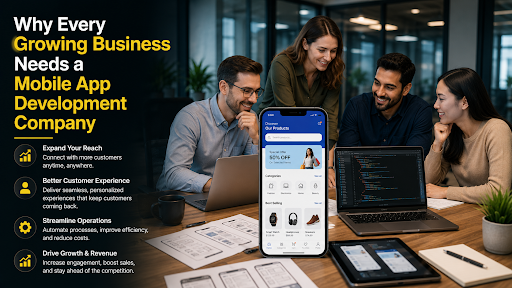
A regional insurance broker I know resisted building a mobile app for four years. His reasoning was consistent: his clients were older, they used the website fine, and the business was growing without one. He wasn’t wrong about any of that. Then a competitor launched a claims submission app, got written up in a regional business publication, and started appearing in conversations where his firm had previously been the obvious choice. Three months later he was in conversations with a Mobile App Development Company trying to close a gap that had taken eighteen months to open and would take at least a year to close.
The thing about mobile apps for growing businesses is that the argument for building one rarely feels urgent until it suddenly is. The competitor that didn’t have an app either, the customers who seemed fine with the existing experience, the business growing without one — these make the decision feel deferrable right up until the moment they don’t.
Here’s what’s actually at stake, and why the businesses getting ahead of this decision consistently outperform the ones catching up to it.
The Channel Your Customers Are Already On
Somewhere north of six hours a day. That’s roughly how much time the average adult spends looking at a smartphone screen in 2026. Not a computer, not a tablet — a phone. And the overwhelming majority of that time is spent inside apps rather than browsers.
This matters for growing businesses in a specific, practical way. Every business has a channel where customers are most reachable and most receptive. For most consumer-facing businesses, and an increasing number of B2B ones, that channel has shifted to mobile. A business without a presence there isn’t just missing a feature — it’s absent from the place where its customers spend most of their attention.
A website accessed through a mobile browser isn’t an equivalent substitute. Browser sessions are shorter, more interrupted, and produce lower engagement than equivalent time in an app. Push notifications reach users in real time in ways that email and browser notifications simply don’t match. The ability to work offline, to access camera and location hardware, to integrate with the device’s payment and authentication systems — none of these are available through a browser experience, and users who’ve become accustomed to native app experiences feel their absence.
Customer Relationships Built Into the Operating System
There’s something structurally different about the relationship a business has with a customer through a mobile app compared to every other channel. The app lives on the home screen. It’s part of the customer’s daily environment in a way that a website, a mailing list, or even a social media following isn’t.
A notification from an app appears the same way a text message does — immediately, on the screen the customer is already looking at. Used thoughtfully, this is one of the most direct communication channels available to any business. Used carelessly, it erodes trust faster than any other channel can. The businesses that get this right use push notifications for things customers genuinely want to know about, at the moments they’re actually useful. The ones that get it wrong are the ones whose apps get deleted.
The data a business can gather through its own app is also qualitatively different from what’s available through third-party platforms. Behavioral patterns, feature usage, session frequency, conversion flow — this is first-party data that belongs to the business and improves over time. A business that has spent three years building a direct mobile channel owns something that no algorithm change or platform policy shift can take away, which is an increasingly meaningful competitive asset as third-party data becomes less available and less reliable.
Operational Efficiency That Compounds
The business case for mobile apps often gets framed entirely around customer-facing value. The operational value gets less attention and is frequently just as significant.
Field service businesses that put job management in a mobile app eliminate paper dispatching, reduce phone traffic between dispatchers and technicians, and give managers real-time visibility into job status without anyone having to call anyone. Retail businesses that give staff mobile access to inventory data reduce the “let me check in the back” cycle and the sales lost when that check takes too long. Service businesses that let customers self-schedule, self-check-in, and access their own account history reduce inbound contact volume for tasks that don’t actually require human interaction.
These operational improvements don’t require consumer-facing apps with large download numbers to justify the investment. An app used by twenty employees that eliminates two hours of manual coordination per day per person is generating real financial return regardless of whether anyone outside the company ever downloads it.
The Loyalty Mechanism That Actually Works
Loyalty programs are everywhere and most of them produce negligible behavioral change, because points accumulated on a physical card or tracked in an email that gets ignored don’t create the kind of frictionless, habitual engagement that actually influences behavior.
Mobile apps change the loyalty equation in two specific ways. First, they reduce the friction of engagement to essentially zero — a customer whose loyalty account lives on their phone doesn’t have to remember a card, look up a number, or find an old email. Second, they make the value of loyalty visible in real time, which creates the kind of immediate reinforcement that actually influences repeat behavior rather than the deferred gratification of a mailed statement.
The businesses reporting the strongest retention numbers from loyalty programs are almost universally ones running them through mobile apps rather than physical cards or email. The channel isn’t incidental to the outcome — it’s the mechanism.
Mobile Application Development Cost vs. the Cost of Not Building
Mobile application development cost is the objection that comes up fastest in every conversation about whether to build, and it’s worth addressing directly. A well-built mobile app from a capable development team typically runs somewhere between $50,000 and $250,000 depending on complexity, platform choice, and the scope of integrations required. That’s a real number that requires real budget justification.
The comparison that rarely gets made explicitly is against the cost of the alternative — customer acquisition spend on channels that don’t compound, operational inefficiencies that continue accumulating, and the competitive gap that opens when a faster-moving competitor builds the channel first and occupies the customer’s home screen before you do.
The insurance broker’s story is instructive here. His four years of deferral cost him a competitive position that took longer and more to recover than the original build would have required. The app he eventually built wasn’t cheaper for having been delayed. It was more expensive, because it had to be built under competitive pressure with a faster timeline and against a competitor who’d already established the category in customers’ minds.
The Timing Question
The businesses that benefit most from mobile apps aren’t the ones that build once they’re large enough to justify it. They’re the ones that build while they’re growing — while the app can be part of shaping how customers experience the brand rather than playing catch-up to expectations already set by competitors.
An app built during a growth phase shapes customer behavior from early in the relationship. An app built after a competitor has already established category expectations is fighting for a place in a customer’s routine that’s already partly occupied.
The right time to build isn’t when the argument feels urgent. It’s before it does.
What Growing Businesses Should Actually Look For
A mobile app built for a growing business needs to be built with growth as a genuine design constraint — not just technically scalable, but architecturally flexible enough to accommodate features and integrations that don’t exist yet because the business isn’t large enough to need them yet.
A development partner worth trusting here asks about the roadmap, not just the current brief. They want to understand where the business is going, not just where it is, because the decisions that determine whether an app can grow with a business get made in the first few weeks of a build, mostly invisibly, and mostly in ways that only become visible once the business has outgrown the assumptions that shaped them.
That conversation — about growth trajectory, about what the business will need in two years, about which architectural shortcuts are harmless and which ones carry a deferred cost — is one of the better signals that a development partner is thinking about the right things.