
Small and mid-sized businesses rarely fail at ERP adoption because they picked the wrong software. They fail because they built the wrong way. A logistics firm in Ohio recently spent eight months and nearly $180,000 on an ERP rollout. Their team never used half the features they paid for. That story repeats across industries, and it’s rarely a technology problem. It’s a planning problem.
Modular design has quietly become the answer. Instead of building one massive system that tries to do everything at once, teams now build smaller, connected pieces. These pieces can be added, replaced, or scaled independently. Many SMBs report development cost reductions of up to 40% after making this shift. The savings aren’t theoretical either. They show up in shorter timelines, leaner teams, and fewer expensive surprises down the road.
Why Traditional ERP Builds Drain Budgets
Traditional ERP systems were designed for a different era. Companies once had years to plan, deep IT budgets, and predictable growth. That world doesn’t exist anymore. Markets shift faster. Customer expectations change within a single quarter, not a five-year cycle.
Consider a mid-sized manufacturer. They might need inventory tracking today but won’t need multi-warehouse logistics for another two years. A traditional build still charges them for that future capability upfront. Every unused module quietly inflates the invoice, and most businesses don’t notice until the final bill arrives.
Maintenance creates a second problem. When everything sits tightly coupled into one system, small changes ripple outward fast:
- A tweak to the accounting module can break something in procurement
- Developers spend more time untangling dependencies than improving the product
- Testing takes longer with each release
- Deployments carry more risk
- Costs keep climbing well after the initial build wraps up
None of this is obvious at the start. It usually surfaces six or eight months into a rollout, once the system is already live and too expensive to rebuild from scratch.
The Modular Shift
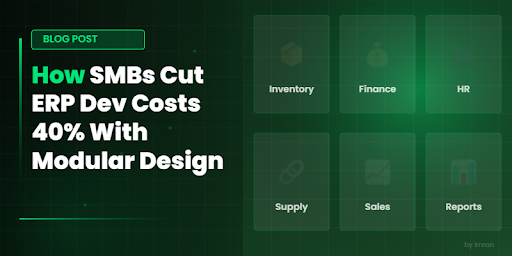
Modular ERP flips this logic. Each function, whether inventory, HR, finance, or procurement, exists as its own component. These components communicate through APIs. They don’t depend on each other to function, which changes how a business can approach its own growth timeline.
This distinction matters more than it sounds. A custom ERP software development solutions approach built on modularity lets a business start with only the pieces it needs. A dental clinic chain might begin with patient scheduling and billing. Six months later, they can add inventory management for supplies without touching the original codebase. Nothing about the earlier work needs revisiting.
Take a regional auto parts distributor as a real-world example. They needed order management and supplier tracking right away. Their HR needs were still evolving, though, since headcount hadn’t stabilized yet. Building modularly let their developers ship the core system in ten weeks. A full-suite build would have taken five months. Payroll integration came later, once their headcount actually justified the investment.
Three things drive the cost savings here:
- Development teams write less code initially
- Testing cycles shrink since modules get validated independently
- Future upgrades touch only the changing piece, not the entire system
Businesses also gain something harder to quantify: flexibility. They can react to a new regulation or a sudden market opportunity without waiting on a lengthy redevelopment cycle.
Where the Real Savings Come From
It’s tempting to assume the 40% figure comes purely from writing less code. That’s only part of the story.
Most savings actually come from avoided rework. Businesses that try to predict every future requirement during initial development often guess wrong. Requirements shift constantly. Regulations change without warning. New sales channels open up that nobody planned for two years earlier. A retailer might add curbside pickup or a subscription model overnight, and their ERP needs to keep pace.
Modular systems absorb that uncertainty far better. Developers add a module or adjust one piece instead of ripping apart an entire application. This alone saves weeks of engineering time per change. Those weeks add up fast over a system’s lifespan, sometimes stretching into months of saved effort across a few years.
Team structure benefits too:
- Smaller, well-defined modules give junior developers room to work safely
- Senior engineers don’t need to review every single line
- Mistakes stay contained instead of spreading across the system
- Companies can run a leaner, less expensive team without sacrificing quality
This last point often gets overlooked. A leaner team isn’t just cheaper. It’s also faster to coordinate, since fewer people need to sign off on every decision.
Choosing the Right Development Partner
None of this works well without the right technical foundation. Poor modularity, meaning too many microservices or weak API contracts, can create more chaos than the monolith it replaced. A business can end up with ten small problems instead of one big one, which isn’t actually progress.
This is exactly where an experienced ERP software development company earns its value. Early architecture decisions shape everything that follows. How modules talk to each other matters. Where data lives matters. How authentication works across pieces matters too. These choices determine whether a company saves money for years or inherits a tangled mess later.
Arobit has watched this pattern play out repeatedly. Their team has helped SMBs across manufacturing, healthcare, and distribution rebuild their operational backbones. The businesses that succeed usually map out what they need now versus later. They resist the urge to future-proof everything on day one, and that restraint tends to pay off within the first year alone.
Looking Ahead
Modular ERP isn’t a passing trend. AI-driven automation keeps evolving. Industry-specific compliance requirements keep shifting too. The ability to swap out or upgrade a single module, without a full system rebuild, will only grow more valuable. Businesses adopting this approach now are positioning themselves to adapt faster than competitors stuck with rigid, all-or-nothing systems.
The math stays simple, even when the engineering isn’t. Build only what you need. Connect it well. Leave room to grow. That’s how SMBs cut ERP costs without cutting corners. It’s a lesson worth applying before the next system overhaul lands on someone’s desk, not after the invoice does.
FAQs
- Is modular ERP suitable for very small businesses, or only mid-sized companies?
Modular ERP actually benefits small businesses more in some ways. They can start with one or two modules and expand only when needed. Upfront costs stay manageable even on tight budgets.
- How long does it typically take to build a modular ERP system compared to a traditional one?
Initial rollout usually moves faster, often 30-50% quicker. Teams focus only on immediate priorities. Full long-term timelines vary depending on how many modules get added over time.
- Does modular ERP require more ongoing maintenance since it has multiple separate components?
Not usually. Teams can test and update isolated modules individually. This often reduces maintenance effort compared to untangling one large interconnected system.