
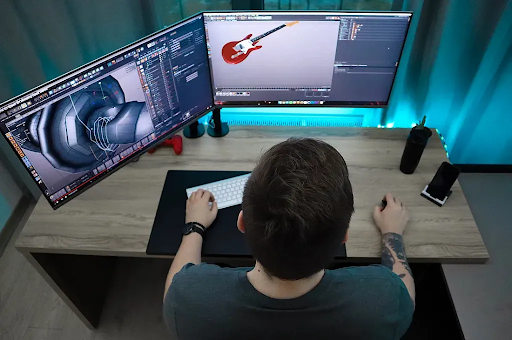
There was a time, not too long ago, when 3D modeling was a niche dark art practiced by basement-dwelling game developers and high-end Hollywood VFX houses. If you wanted something modeled in 3D, you needed a massive budget and a six-month lead time.
Today, the script has flipped. From the “View in your Room” button on a furniture website to the digital twins used to stress-test a New York skyscraper before the first steel beam is forged, 3D modeling is the silent engine of the modern economy.
But as the technology becomes more accessible, a new problem has emerged: The Quality Gap. In a world flooded with cheap, outsourced, and AI-generated “good enough” assets, how do American businesses maintain a standard of excellence? The answer lies in specialized, domestic 3D modeling services in the USA.
1. What Exactly Are We Talking About? (Beyond the Jargon)
At its simplest, 3D modeling is the process of using specialized software to create a mathematical representation of any three-dimensional surface. It’s like digital sculpting, but instead of clay, you’re using “vertices,” “edges,” and “polygons.”
However, in a professional service context, it’s much more than just “making a shape.” It involves:
- Hard-Surface Modeling: Think of things with defined, man-made edges—cars, watches, architectural structures, and industrial machinery.
- Organic Modeling: This is the “soft” stuff—human anatomy, plants, characters, and fabrics. This requires a deep understanding of how things move and deform in the real world.
- Photogrammetry: Taking hundreds of photos of a real object and using software to “stitch” them into a 3D replica.
2. The “Made in USA” Edge: Why Locality is a Strategic Asset
In an era of global fiber-optic internet, why does it matter if your modeler is in Topeka or Timbuktu? For high-stakes projects, the “USA” tag isn’t just about a flag; it’s about alignment.
The Communication Nuance
Have you ever tried to explain the “vibe” of a mid-century modern living room to someone who has never seen one in person? Or the specific safety requirements for a US medical device? When you partner with a domestic brand like IT-S, you aren’t fighting a language barrier or a 12-hour time difference. You’re working with people who understand the American consumer’s expectations for realism and quality.
Intellectual Property (IP) and Security
If you are developing a prototype for a patented invention, your 3D files are your crown jewels. The US legal system offers a level of IP protection that is often unenforceable in offshore markets. Working with a domestic service provider ensures your data stays within a jurisdiction where your contracts actually mean something.
Technical Standards
The US market is incredibly demanding regarding “Real-Time” performance. Whether it’s for Apple’s Vision Pro or a high-end web configurator, US-based teams are often at the bleeding edge of the hardware and software required to make these experiences seamless.
3. The Anatomy of a Professional 3D Workflow
To understand what you’re paying for when you hire a professional service, you have to look under the hood. A “humanized” workflow isn’t a factory line; it’s a series of artistic and technical decisions.
Phase 1: The Brief and Reference Gathering
A professional modeler doesn’t just start clicking. They study. They look at blueprints, material samples, and real-world lighting. This is where IT-S differentiates itself—by asking why the model exists before asking how it should look.
Phase 2: Blocking and Topology
This is the skeleton. A good modeler focuses on “clean topology.” This means the lines of the model flow in a way that allows it to bend or reflect light without “pinching.”
Phase 3: Texturing (PBR Workflow)
Physically Based Rendering (PBR) is the gold standard. It’s a method of shading that mimics how light actually bounces off real-world materials. A professional doesn’t just “color” a model; they define its “roughness,” its “metallicity,” and its “subsurface scattering” (the way light glows through skin or wax).
Phase 4: Optimization
This is where the “art” meets the “engineering.” A 50-million-polygon model is useless if it crashes your website. Professional services specialize in “baking” high-detail data onto low-detail models, giving you the look of a masterpiece with the speed of a racing car.
4. Industry Impact: Who is Using 3D Modeling?
If you think 3D modeling is just for “tech companies,” think again. The reach of 3D modeling services in the USA extends into almost every sector.
- E-Commerce and Retail: Major brands are replacing traditional photography with 3D renders. Why? Because you can’t “re-photograph” a couch in 50 different fabric colors in a studio for the same cost as a digital texture swap.
- Architecture and Real Estate (ArchViz): Selling a building that hasn’t been built yet is an exercise in imagination. 3D walkthroughs allow investors to “feel” the space, leading to faster pre-sales and fewer design change orders during construction.
- Healthcare: Surgeons now use 3D-modeled organs based on patient MRIs to plan complex operations. This isn’t just “visuals”—it’s life-saving precision.
- Manufacturing: Digital twins allow factories to simulate wear and tear on a machine before it ever hits the assembly line, saving millions in potential downtime.
5. Common Pitfalls: What to Avoid When Hiring
Not all 3D services are created equal. If you are looking to hire, watch out for these “red flags”:
- The “Hidden” Polygon Count: A service delivers a beautiful image, but the file they give you is so “heavy” it’s unusable for your app. Always ask about optimization.
- Lack of Revisions: 3D modeling is an iterative process. If a provider doesn’t bake a revision cycle into their quote, walk away.
- Static Assets: In 2026, a 3D model should be versatile. Can it be used for a video, an AR filter, and a high-res print? A professional team like IT-S builds assets with “future-proofing” in mind.
6. The Human Element: Why AI Isn’t Taking Over (Yet)
There is a lot of talk about AI generating 3D models. While AI is a great tool for generating “base shapes,” it lacks the “intent” that a human artist provides.
AI doesn’t understand that a specific bolt on a machine needs to be accessible for a wrench, or that a certain fabric should drape “luxuriously” rather than “stiffly.” The humanized approach—where an artist at IT-S reviews every vertex—ensures that the final product doesn’t just look “correct” to a computer, but feels “right” to a person.
7. Looking Ahead: The Future of 3D in the USA
We are moving toward a “spatial” internet. With the rise of wearable headsets and the integration of 3D into standard web browsers, the demand for high-quality assets is going to explode.
Companies that invest in a solid library of 3D assets today are essentially building their digital real estate for the next decade. By choosing a domestic partner who prioritizes quality over shortcuts, you ensure that your brand is ready for whatever screen (or lens) comes next.
Final Thoughts
3D modeling is no longer a luxury; it is a vital language for business. It bridges the gap between what you can do and what your customers see.
When you look for 3D modeling services in the USA, you are looking for more than a technician. You are looking for a translator—someone who can take your raw concepts and turn them into a digital reality that moves the needle for your business. That is the mission behind IT-S: combining technical rigor with a human touch to bring your vision to life in three dimensions.