
Complex biologics produced in manufacturing facilities must meet the highest safety and efficacy standards. Their structure and functionality must be identical or at least highly similar to the native form.
While simple microbial systems like E. coli and yeast provide the speed and simplicity required for large-scale production, they are unable to perform necessary post-translational modifications (PTMs).
Lack of these modifications can lead to:
- Misfolded proteins
- Lack of biological activity
- Rapid degradation when administered clinically
Mammalian Cell Culture
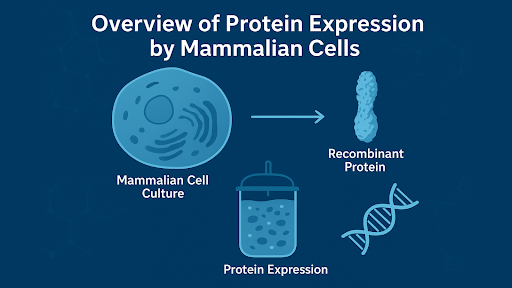
Mammalian cell culture uses specific eukaryotic cell lines (such as Chinese Hamster Ovary (CHO), Baby Hamster Kidney (BHK-21), and Myeloma cells) equipped with cellular machinery required to ensure that proteins are:
- Correctly folded
- Properly assembled into multi-subunit complexes
- Receive essential carbohydrate moieties
These vital features ensure that the protein is stable, biologically specific and remains active and functional in the bloodstream.
Commercial applications require large batches of high-quality products. A stable expression approach is essential for permanent integration of the therapeutic gene into the host cell’s genome.
Establishing Stable Expression
Host Selection
Chinese Hamster Ovary (CHO) cells are the industry gold standard as they are eukaryotic and equipped with the cellular machinery necessary to perform human-like protein modifications. Their ability to grow continuously and adapt to large-scale suspension culture make them ideal for commercial manufacturing.
Vector Design
The expression vector carries genetic instructions for the therapeutic protein. It is a custom-designed, circular DNA molecule that delivers the gene of interest into the nucleus of the host cell. It also ensures high-level, stable production of the therapeutic protein.
Transfection and Selection
Transfection is the process of inserting the foreign DNA of the expression vector into the CHO host cell. A selectable marker is used to isolate the cells that have incorporated the gene.
Gene Amplification
Chemical inhibitors such as Methotrexate (MTX) target the DHFR enzyme. The concentration of these chemical inhibitors is gradually increased to maximize the output, known as gene amplification.
The Intracellular Quality Control Mechanism
Protein Translocation and ER Folding
As a ribosome translates the therapeutic protein, the Signal-Recognition Particle (SRP) complex recognizes a signal sequence on the peptide. This complex docks the entire ribosome-peptide unit onto the ER membrane and allows the peptide to enter the Endoplasmic Reticulum membrane.
The ER environment is optimized for folding. As a result, the end product has the correct 3D structure. This also ensures that multi-subunit complexes are properly assembled.
The Quality Gate and Glycosylation
The ER acts as a Quality Gate that allows only correctly folded and assembled recombinant bio-proteins to exit the ER. These proteins are then moved to the Golgi apparatus for glycosylation maturation.
Clinical Relevance
The success of the therapeutic protein depends on glycosylation. The pattern of sialylation determines the lifespan and activity in vivo. Proper sialylation ensures that the liver receptors do not prematurely recognize the protein and clear them from the bloodstream. This maximizes the circulatory half-life and therapeutic efficacy.
Culture Optimization
Culture optimization is essential to maintain cell health and maximize yield when moving from lab to commercial volume.
Media Complexity and Metabolic Challenges
Mammalian cells demand precisely formulated media with all essential amino acids, vitamins, hormones, and growth factors to ensure sustained cell growth and high protein expression.
Metabolic challenges are a major obstacle at high cell densities. Mammalian cells can convert glucose to lactate and glutamine to ammonia. These toxic byproducts can adversely affect cell growth and reduce recombinant bioproteins production.
Media optimization and precisely controlling the perfusion rate help remove waste to overcome metabolic challenges.
Bioreactor Production and Product Impact
The cell culture process is then moved to bioreactors, large, sterile, controlled industrial tanks. The following are the two main production methods in a bioreactor:
Batch Culture
Cells in batch culture are fed only once and production stops when all the nutrients are used up or waste becomes toxic.
Continuous Perfusion Culture
In this advanced method, media is pumped and waste is removed constantly. As a result, cells are healthy at a maximum density and produce recombinant bio-proteins for weeks or months.